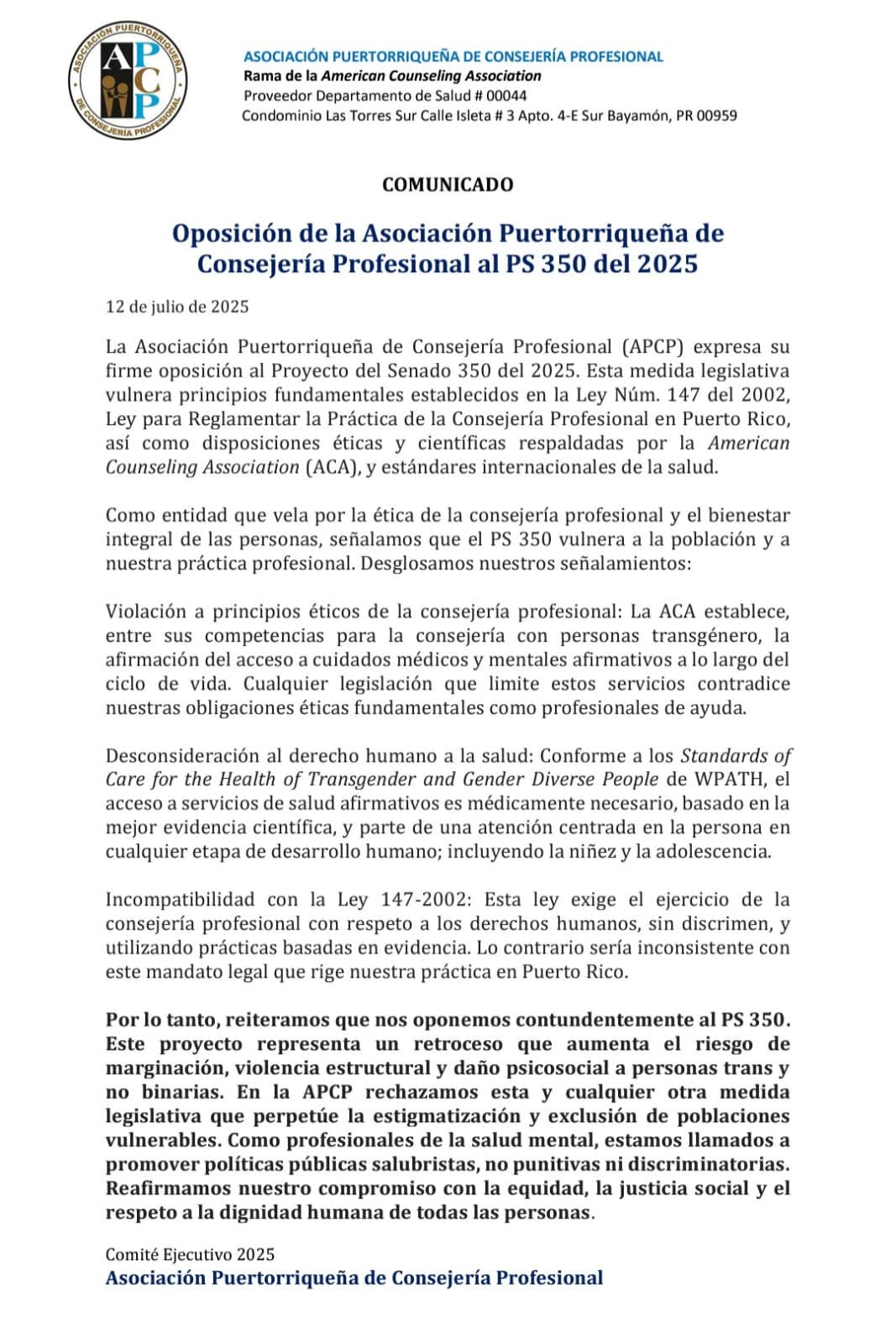
La Asociación Puertorriqueña de Consejería Profesional (APCP) pidió que no se convierta en ley el Proyecto del Senado 350 por criminalizar a los profesionales de la salud mental por brindar terapias con el consentimiento de padres y madres de personas trans menores de 21 años.
“Nos oponemos contundentemente al PS 350. Este proyecto representa un retroceso que aumenta el riesgo de marginación, violencia estructural y daño psicosocial a personas trans y no binarias. En la APCP rechazamos esta y cualquier otra medida legislativa que perpetúe la estigmatización y exclusión de poblaciones vulnerables”, reza la resolución de la APCP.
En estos pasados días, tanto el Colegio de Médicos Cirujanos como el Colegio de Profesionales del Trabajo Social exigieron un veto de la gobernadora a esta medida que establece una pena de reclusión de 15 años, una multa de $50,000 y la revocación de las licencias de los profesionales de la salud que realicen a menores de 21 años terapias de afirmación de género, las cuales están aprobadas por todas las asociaciones médicas a nivel nacional e internacional.
Finalmente, la Asociación de Consejería Profesional concluyó aseverando que «como profesionales de la salud mental, estamos llamados a promover políticas públicas salubristas, no punitivas ni discriminatorias. Reafirmamos nuestro compromiso con la equidad, la justicia social y el respeto a la dignidad humana de todas las personas”.
Puerto Rico, long regarded as a leader on transgender rights in the Caribbean, is facing a potential rollback as lawmakers push forward legislation to ban gender-affirming care for youth. The measure could criminalize parents and doctors and cut off vital medical support for the island’s trans community.
The bill, approved by both chambers of Puerto Rico’s legislature, is now awaiting action by Republican Gov. Jenniffer González Colón. Although she had proposed amendments to protect access to puberty blockers and allow minors already undergoing treatment to continue care, lawmakers did not adopt those changes. The governor now faces a decision to sign or veto the bill. The U.S. Supreme Court recently ruled that the government can limit this kind of care.
Late last month, the Puerto Rican Senate advanced the legislation, which would bar gender-affirming health care for trans people under 21 and impose fines, prison time, and professional sanctions on parents and medical providers who facilitate such care. The House recently passed the bill as well, starting a 30-day clock for the governor to act.
Parents of trans youth have pleaded with the governor to veto the bill, but instead, she sent it back for changes that ultimately failed.
Pedro Julio Serrano, president of the Puerto Rico LGBTQ+ Federation, stated that the island has long been “at the forefront” of trans rights, citing milestones such as allowing trans people to change their birth certificates and a recent court ruling that enabled nonbinary individuals to have an “X” gender marker. However, he warned that the political climate has shifted dramatically.
He told The Advocate that conservative forces in Puerto Rico, particularly the fundamentalist party Proyecto Dignidad, are using anti-trans legislation as a calculated political strategy to attract voters. Serrano noted that the same types of bills now moving through the legislature were blocked in the previous term through activism and lobbying, but have resurfaced under a more conservative government.
The current bill follows the passage of a religious liberty measure and another effort restricting care for trans minors, both of which Serrano said the community is also preparing to challenge in court. “We are on that waiting stage,” he said.
Serrano stressed that while Puerto Rico’s political environment has become more hostile, the island’s broader culture remains deeply supportive of LGBTQ+ people. He described Puerto Rico as a place that is generally “accepting, welcoming, respectful,” and one of the world’s top LGBTQ+ travel destinations. Yet, he acknowledged that pockets of violence and bigotry persist, recalling how Puerto Rico was the epicenter of anti-trans violence in 2020 when seven trans people were murdered.
He noted that the federation formed shortly after the 2020 election, anticipating conservative political gains both locally and nationally. Since then, the coalition has grown to include over 100 organizations and numerous political and community leaders. Its work has included large-scale marches, legislative outreach, community assemblies, legal planning, and grassroots organizing.
Serrano said the island has experienced a groundswell of local activism, with Pride events expanding from one march in San Juan decades ago to more than 20 events across Puerto Rico today, including on smaller islands like Vieques. He said the community is determined to resist efforts to strip away hard-won rights, even if the fight is long and complex. “We know that we’re going to have some setbacks,” he said. “But if we don’t do the fight right now, it’s going to be even harder to win back those things that are taken away from us.”
Groups, including the Puerto Rico LGBTQ+ Federation and GLAAD, condemned the legislation, warning that it would impose unbearable burdens on families and cut off trans youth from lifesaving health care. “Lawmakers must vote to protect access to health care that saves lives, and allow families to make private health care decisions that help loved ones be themselves, be safe, and to thrive,” the groups said in a joint statement.
Advocates also stress that, unlike in the contiguous United States, trans Puerto Ricans cannot simply travel to a neighboring state for care if services are banned locally. Many would be left without options unless they could afford expensive travel to the mainland. Puerto Ricans are U.S. citizens but cannot vote for president in the general election unless they reside on the mainland.
Despite political divisions, President Donald Trump’s influence remains limited on the U.S. territory.
“People don’t forget when he threw paper towels at us,” Serrano said, referring to Trump’s widely criticized visit after Hurricane Maria, which many on the island saw as dismissive and insulting during a humanitarian crisis. Serrano added that even Republicans on the island often distance themselves from Trump, and that his policies do not hold the same sway in Puerto Rico as they might in some U.S. states.
The Advocate contacted the Puerto Rican governor’s office to ask whether she plans to sign or veto the bill, but did not receive a response.
La presidenta del Colegio de Profesionales del Trabajo Social de Puerto Rico, Lydael Vega Otero, solicitó a la gobernadora a no convertir en ley el Proyecto del Senado 350 por criminalizar a los profesionales de la salud mental por brindar terapias con el consentimiento de padres y madres de personas trans menores de 21 años.
“El trabajo social se centra en la identificación y atención de las necesidades como un imperativo de justicia social y derecho. Nuestra organización reconoce que la atención de afirmación de género desde un enfoque holístico que aborda las necesidades médicas, psicológicas y sociales de las personas trans, promueve su bienestar y protege sus derechos.”, aseveró Vega Otero.
En una carta enviada a la gobernadora Jenniffer González Colón, Vega Otero aseveró que “los modelos de afirmación de género se centran en validar y apoyar la identidad de género de las personas, reconociendo que esta puede ser diferente a la asignada al nacer. Estos modelos buscan crear un entorno seguro y respetuoso, donde las personas trans y género diversos puedan expresar su identidad libremente y acceder a servicios que les permitan vivir de acuerdo con ella”.
Ayer, el Colegio de Médicos Cirujanos envió una carta similar pidiendo el veto a la medida que establece una pena de reclusión de 15 años, una multa de $50,000 y la revocación de las licencias de los profesionales de la salud que realicen a menores de 21 años terapias de afirmación de género, las cuales están aprobadas por todas las asociaciones médicas a nivel nacional e internacional.
Finalmente, Otero Vega pidió a la gobernadora “vetar esta medida que pone en peligro a jóvenes trans que necesitan atención médica y de salud mental que los profesionales de nuestro colegio estamos dispuestos a ofrecer”.
El presidente del Colegio de Médicos Cirujanos de Puerto Rico, doctor Carlos Díaz Vélez, exhortó a la gobernadora a vetar el Proyecto del Senado 350 porque criminaliza a los profesionales de la salud por tomar decisiones médicas junto a los padres y madres de personas trans menores de 21 años.
“Le solicitamos, respetuosamente a la gobernadora Jenniffer González Colón a que vete el Proyecto del Senado 350, pues no tan solo atenta contra la relación sagrada entre médico y paciente; sino que amenaza con enviar a la cárcel con 15 años en prisión a los profesionales de la salud que realicen terapias de afirmación de género que han sido validadas por todas las asociaciones médicas nacional e internacionalmente”.
La medida establece una pena de reclusión de 15 años, una multa de $50,000 y la revocación de las licencias de los profesionales de la salud que realicen terapias de afirmación de género a menores de 21 años.
En una carta enviada a la gobernadora Jenniffer González Colón, el doctor Díaz Vélez aseveró que “las entidades de la salud han establecido que los tratamientos de afirmación de género, cuando son administrados bajo la debida supervisión médica y psicológica, son esenciales para el bienestar y la salud mental de las personas trans. Esta legislación no sólo margina aún más a la niñez y juventud trans, sino que también les niega el acceso a servicios médicos esenciales que podrían salvar sus vidas”.


 Pedro Julio Serrano